

When a Straw Became Smart: The Story of Sense N' Sip
When the Multi-sensory Design course began, our team was challenged to move beyond visual interfaces.
This is how Sense N' Sip was born. Our goal was clear: track specific liquid intake, whether water for hydration goals, or measuring sugar and alcohol via ounces, using non-visual cues.
Sip N' Sense
August 2025 - October 2025
Role: Product Designer
Research Methods: Interviewing, Qualitative Analysis, Surveying, Usability Testing
Team: Journey Brown-Saintel, Jackie Nam
Problem Area
Market Gap
While there are many hydration-tracking products (like smart bottles and fitness apps), most:
-
Require manual logging or syncing with external apps/devices.
-
Rely solely on visual interfaces (e.g., phone screens, LED bottles).
-
Fail to provide multisensory, real-time feedback that integrates naturally into the act of drinking.
There is currently no simple, sensory-integrated solution that allows users to track liquid intake passively—without interrupting or changing their drinking habits.
Problem Area
Health-conscious individuals struggle to:
-
Accurately monitor fluid intake throughout the day.
-
Stay consistent with hydration or dietary goals because tracking is often manual, inconvenient, or easy to forget.
-
Access real-time, embodied feedback that’s both subtle and intuitive (without checking a phone or smartwatch).
Problem Statement
Health-conscious individuals often struggle to accurately monitor their daily liquid intake because existing hydration tracking solutions require manual logging or reliance on external apps and devices. This disrupts the natural act of drinking and makes real-time tracking inconvenient. There is a need for a seamless, multisensory solution that provides immediate, intuitive feedback about liquid consumption—helping users stay aware of their hydration levels without interrupting their routine.
Competitive Analysis
LOW-SALT SUPPORT TABLEWARE
Kirin, in collaboration with Meiji University, developed the Low-Salt Support Tableware which amplifies saltiness and umami through the power of electricity.

BUBBLE LICK
Bubble Lick is a flavored, lickable bubble solution designed to be safe for kids, pets, and adults. It was developed in response to concerns about traditional soap-based bubbles; it uses FDA-approved ingredients to reduce health risks while adding fun, edible flavoring.
.png)
SIP N’ SOUND STRAWS
Sip n’ Sound straws are interactive straws that allow the user to hear animated sounds when liquid is passed through them.
.png)
TAKEAWAYS:
.png)
Design Process
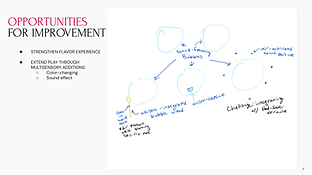
Brainstorming
.png)
.png)
.png)
Iterating on our competitors
Initial Usability Testing
For this project, our team tested a prototype straw that provides multisensory cues (haptic, visual, and audio) to help people track hydration more accurately. Our goal was to see how different sensory outputs affect user experience, preference, and accuracy when monitoring liquid intake.
Key Findings
-
Tracking style – Most participants said they currently track hydration using a water bottle rather than cups, straws, or apps. Bottles were seen as intuitive and familiar.
-
Preferred modality – Users strongly favored haptic (buzzing/touch) feedback because it was subtle, private, and didn’t interrupt their flow.
-
Least preferred modality – Light feedback was disliked. Users found blinking lights distracting, less intuitive, and hard to interpret in everyday contexts.
What does this mean for us?
Overall, users showed that hydration tracking works best when it builds on existing habits (like bottles) and when feedback is subtle and intuitive (haptic).
This testing gives us a clearer direction for iteration: prioritize haptic-first design, explore integration with bottle-based tracking, and reconsider the role of visual cues in hydration tools.
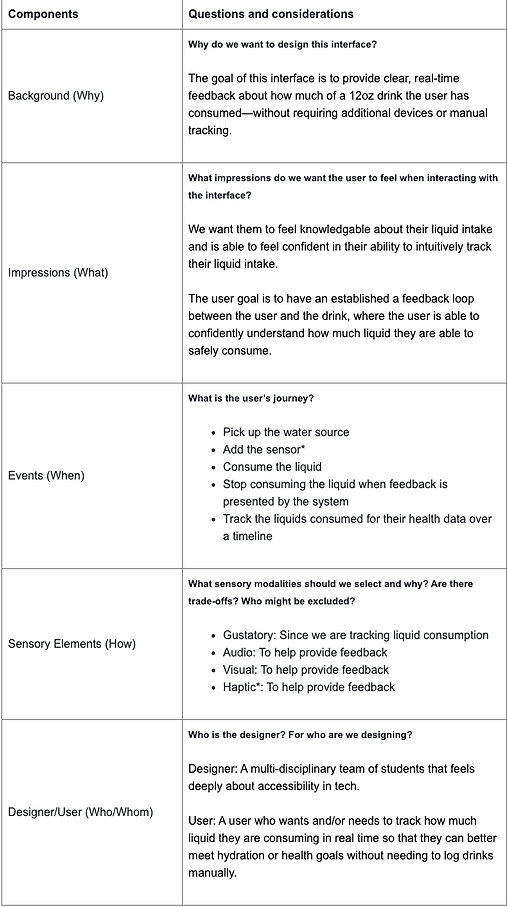
Arduino


Digital Interface
Tactile Interface

Learnings
1. Multisensory Design Expands Communication
First, Multisensory Design is about expanding communication, not replacing one sense with another. Our project is a success because it provides layered feedback in the form of haptic, audio, tactile, and visual cues, proving that complex data like liquid level can be conveyed intuitively without relying on sight alone.
2. Accessibility as the Starting Point
Second, the entire process reinforced that accessibility must be the starting point. By prioritizing layered sensory feedback, we created an equitable product that inherently serves users with a wide range of sensory needs, making it better for everyone.